How many ways to be Catholic?
Dr Michael Hewitt-Gleeson
For 20 centuries there has existed a great matrix of Catholic thinkers. From the Roman Mediterranean and now all around the world.
Today, you can find Catholic thinkers with a Judaic emphasis on tradition, law and judgement. Perhaps the late Cardinal George Pell of Australia was such a thinker.
You can also find innovative thinkers like the late Swiss theologian Fr Hans Kung in a different part of the universal matrix.
So far on Earth there have existed about ten billion human brains yet no two brains have ever been the same. Every brain is different.
Different environment, different experience, different formation, different culture, different DNA, different cognitive wiring.
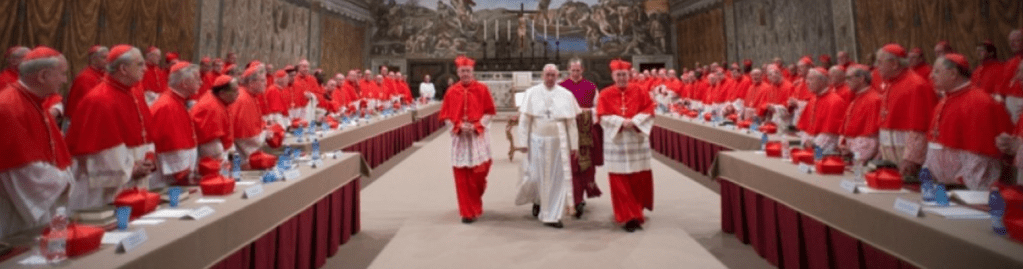
Here is the very first picture taken of Pope Francis minutes after his election. He only wears a white cassock. He wears none of the symbols showing he is, in fact, the last absolute monarch in Europe.
He is quite different to other popes.
He is surrounded by all the Cardinal-electors. They all dress the same but, in fact, no two of those Cardinals are alike. They’re quite different, too. Why? Each of their brains exists in a different environment, with different experience, having had different formation, from different cultures, and of course, different DNA with very different neuro-wiring.
Today there are around 1.3 billion Catholic brains in the world. As it is with all brains, no two Catholic brains can ever be the same.
How many ways are there to be a Catholic thinker?
At present, there are about 1.3 billion different ways to be a Catholic thinker.
This partly explains the success of the church. This broad diversity has helped the Catholic Church survive for over two thousand years.
Many Catholics believe this expansive diversity is evidence of the genius of the Holy Spirit.
We’re the Catholic Church — which means universal. And the different nationalities around the world, different classes of people, different levels of education are attracted in somewhat different ways to different forms of prayer. So I think the variety of rites is part of the Catholic genius. This has to be balanced around unity, of course, but unity does not have to mean uniformity or the suppression of traditional and established and indeed beautiful forms of worship.
– Cardinal Pell
So, what have Catholic thinkers ever done for us?
Catholic Thinking has given us Christmas and The Vatican Archives. It established universities and invented the idea of ‘universal education’. It virally used missionaries to spread this around the world along with many thousands of gratuitous libraries. Catholics run over 220,000 schools globally.
Also, most people don’t know that the Catholic Church is the largest non-government health- provider in the world. It has around 18,000 clinics, 16,000 homes for the elderly and those with special needs, and 5,500 hospitals. 65% of them are located in developing countries.
Catholic culture also offers workers many holidays, family festivals, special ceremonies for passages of life, art and music and, of course, Sunday Mass at local community chapels, churches and cathedrals.
The Catholic Church, based in the Vatican City State, is the most successful human memeplex ever invented, curated and replicated over two thousand years of continuity.
Nothing else even comes close!
For example we have Coke and so we have Pepsi. We have MacDonalds so we also have Burger King. We have Apple so we have Samsung.
Where there’s a #1 there’s a #2 not far behind. But not so with the enduring twenty centuries of the Catholic Church.
What comes a long way second?
One thousand years of The Crown, perhaps.
Catholic covers a fertile memeplex.
It’s eclectic. It’s broad. It’s flexible. It’s coherent. It’s a valuable collection of diverse ideas and themes and narratives that have survived and evolved and stood the test of time.
The early secret Christians of the catacombs, whose password was the fish symbol, had never anticipated Augustine or Aquinas or the Councils or the many Papal Encyclicals. But they shared the same faith as today’s most Vaticanised theologians.
They got their faith directly from the apostles and disciples who passed it on from the lips of Jesus.
I got mine from a Salesian boarding school not long after WWII.
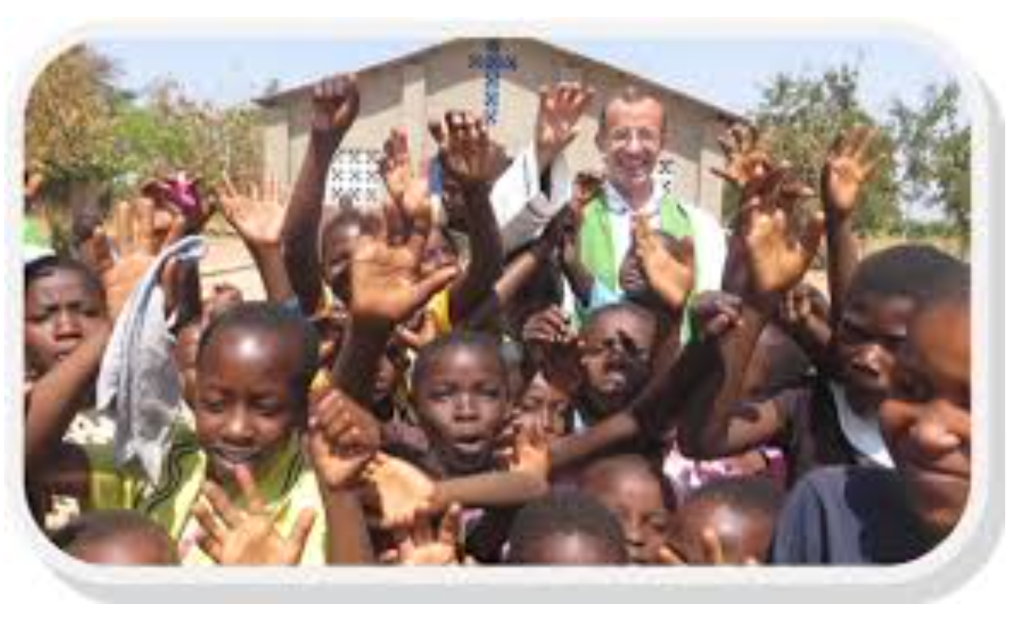
There are youngsters today who are sitting at the feet of missionaries in Africa and whose faith is just as authentic as the early martyrs and the mindful Vaticanologists.
As a social human phenomenon this sustainability is a genuine mystery and a dissonant paradox.
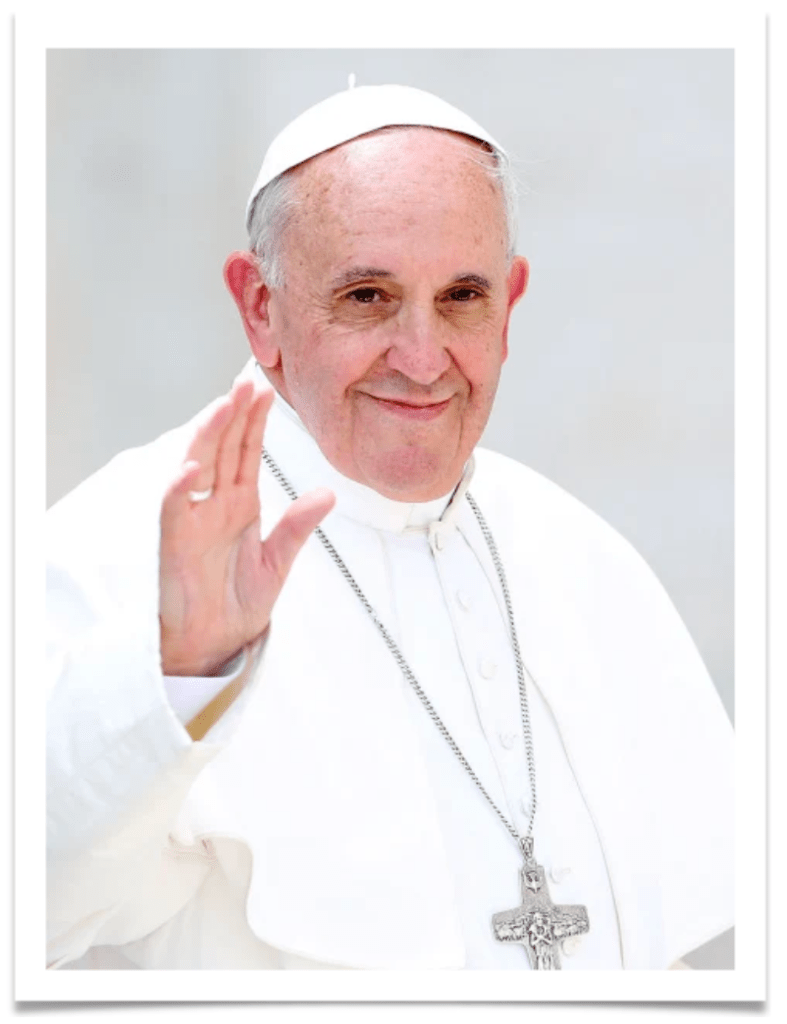
“On many concrete questions, the Church has no reason to offer a definitive opinion; she knows that honest debate must be encouraged among experts, while respecting divergent views.”
– Pope Francis, Laudato Si‘, para 61
The Catholic tradition is deeply held in trust because, for those thinkers who have the gift and conviction of faith, it is transcendent and divine. It is personally inspired by the triune God.
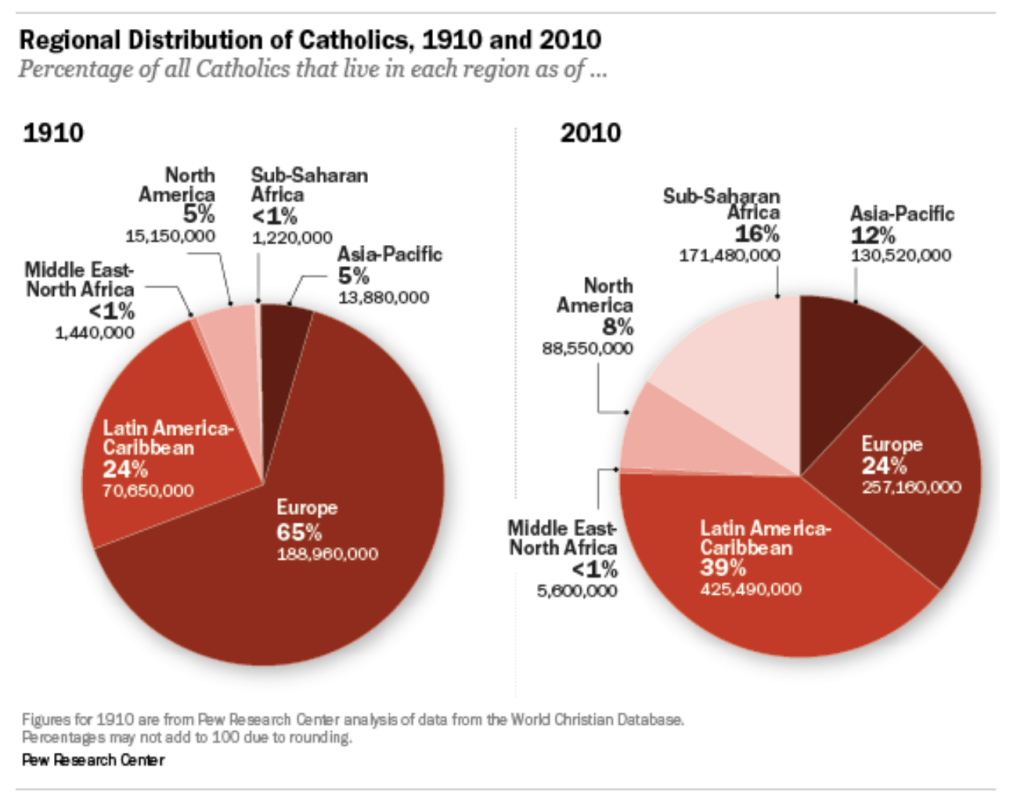
Number of baptised Catholics by country (2010)
Today in 2024, the demographics of the Catholic faithful continues to change globally as the church navigates it’s 2000 year journey.
For example, in Italy about 34% of Catholics go to mass regularly; while in Nigeria it’s 94%.
It is not widely understood that, globally, the majority of mass-attending Catholics are now in sub-Saharan Africa, totalling 95.5 million (37.5 million in the Democratic Republic of the Congo; 30.5 million in Nigeria; 28.2 million in Uganda). No-one explains this better than journalist and Vaticanologist, John Allen.
Catholic is not anti-science
The Church has never been anti-science. It’s just a modern myth and one that is quite far from reality.
Indeed, it has been the main Western repository of knowledge, scholarly research and recorded investigation for the majority of the last 1700 years.
This is the Wikipedia list throughout history of cleric- scientists including Nicolaus Copernicus, Gregor Mendel, Georges Lemaître, Albertus Magnus, Roger Bacon, William of Ockham, and many others.
Nobel Laureate Members of
the Pontifical Academy of Sciences:
https://www.pas.va/en/academicians/nobel.html
The Pontifical Academy of Sciences at Vatican City
Stephen Hawking was a lifetime member of the Pontifical Academy of Sciences, which gathers leading world scientists to advise the Popes on scientific issues.
‘Catholic Thinking’ is a human knowledge tradition. It’s an evolving and very successful tradition. It’s been around a lot longer than ‘science thinking’ which is a relatively recent development in human thinking; for the past 400 years. Many basic scientific techniques such as measurement and observation were long ago pioneered by Catholic thinkers.
As a brand, Catholic means universal. We can see that it also means diversity. Diversity means survival. Survival means growth.
Catholic is not monolithic
Finally, another myth is that all Catholics are the same. This is also absurd and fetched very far from what is true. Catholic is the opposite of monolithic.
Catholic is not rigid and inflexible because there are many differing ways to be a Catholic. For example, Catholic thinkers in Italy may differ from those in America, or China, or Nigeria.
A Catholic thinker like St Francis de Sales may differ from St Thomas Aquinas yet both are revered saints and Doctors of the Church.
There are also levels of knowledge: a child’s education of the catechism is on one level; an adult’s level from Sunday sermons is another level; a priest’s 8 years of formation and theological studies is another level; a bishop’s another; a cardinal’s another and then there are the popes.
In the Catholic matrix, there are over a billion Catholics with different degrees of faith, knowledge and practice, but they identify as Catholic and may claim the church’s community, history, liturgy and social teaching as their inspiration.
Michael Hewitt-Gleeson Rome, 2024
_____________________________________________________________________
Copyright © 2024. The Luciani School.
The Luciani School is a new open independent school. No advocacy and no agenda. No fees, no sponsors, grants or aid and no profit. No accreditation nor imprimatur. It is a school of thinking. Not a school of thought. Our mission is simply metacognition. Luciani School is, therefore, not for everyone. However, all are invited – anyone, anywhere, anytime, 24/7/365. You may visit the Luciani School here: https://popelucianischool.net/
 Pope Luciani School of Catholic Science Thinking